From the 1950s until the 1980s, asbestos was commonly used in the construction and insulation of commercial and residential buildings. It was thought of as a very useful and adaptive mineral. It was later, however discovered to be a leading cause of mesothelioma, as well as other lung cancers/diseases and has been since banned across much of the world.
How Does One Remove Asbestos and Dispose of it Properly?
Here in the UK, the proper disposal of asbestos and any product containing at least 0.1% of asbestos is highly regulated under the Control of Asbestos Regulations, 2012 as a “Hazardous Waste” in England and Wales and “Special Waste” in Scotland. In addition, in England, Scotland, and Wales, such waste falls within the purview of the Carriage of Dangerous Goods Regulations 2009 (CDG 2009). As such, they cannot be disposed of with typical household waste, and there are a number of specific asbestos disposal regulations in the UK for how it is to be bagged and transported so as to not disturb it and make it become airborne. http://www.hse.gov.uk/pubns/guidance/em9.pdf
Bagging Procedures
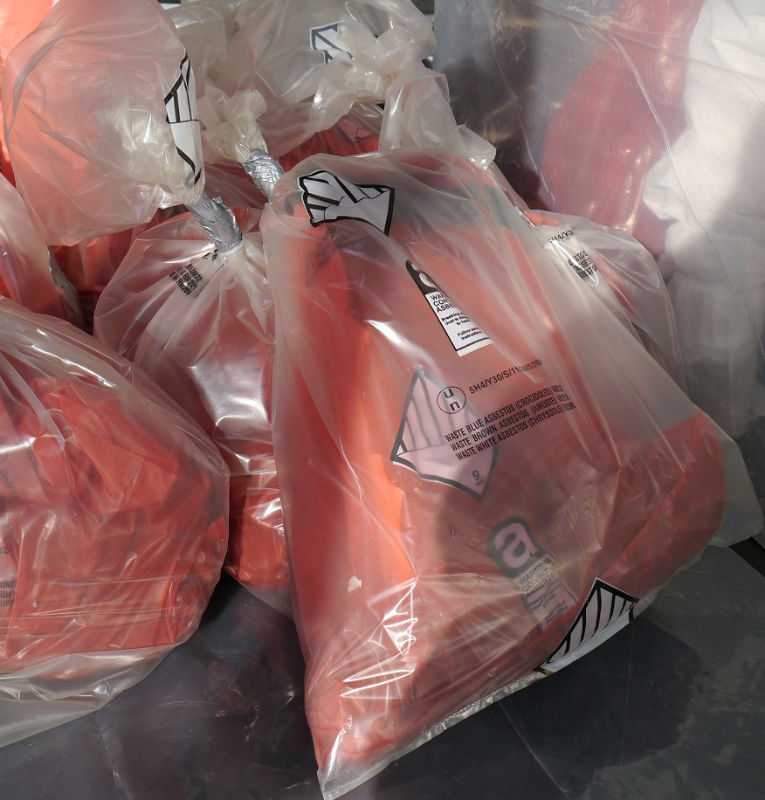
All asbestos-containing waste (with at least 0.1% asbestos materials) is required to be double-bagged with special materials approved by the UN, with particular labelling and warning requirements.
Transportation Issues
In order to move or transport asbestos-containing waste, a sealed skip or a vehicle with a sealed compartment that is readily lockable and cleanable is required. Best practices would demand that a registered waste carrier be notified and selected rather than a personal vehicle.
Personal Safety
Should you wish to try to remove it on your own, keep the following suggestions in mind because the asbestos fibres become dangerous when they are airborne and inhaled. First, appropriate protective clothing and face masks are required to keep the fibres from attaching to you or for you accidentally breathing them. Gloves are also, of course, necessary. You should not use your own personal vacuum cleaner or mix the items or allow large sheets or materials to be broken.
The safest choice, without a doubt, is to hire a professional to come in, evaluate the situation, identify the best way to remove it through surveying, sampling and testing, and handle the removal and disposal directly to ensure compliance with asbestos disposal regulations.