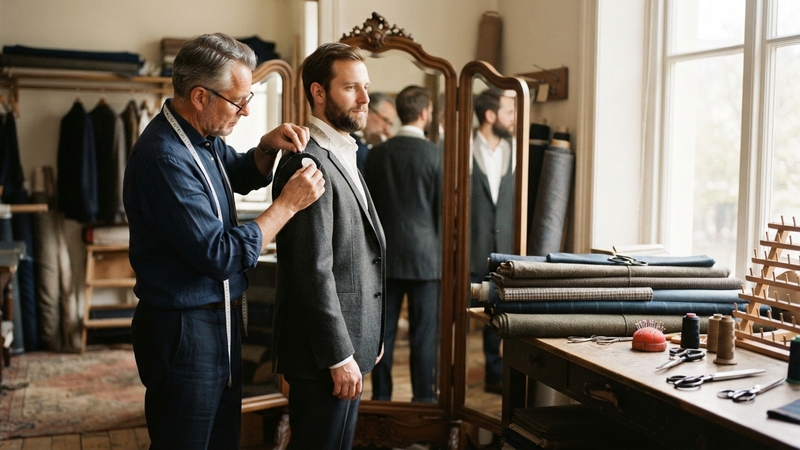
- Custom tailoring builds garments around a person’s exact measurements rather than fitting a person into a pre-set size.
- Suits, dresses, and formalwear benefit most from custom fitting, especially for weddings, black-tie events, and professional wardrobes.
- Washington, DC residents can access custom tailoring services from providers based in nearby Arlington, VA.
Custom tailoring refers to the process of constructing or adjusting a garment specifically around an individual’s body measurements, rather than relying on standardized retail sizing. The result is clothing that follows the actual contours of the wearer, correcting common fit problems like pulling at the buttons, excess fabric at the waist, or sleeves that sit too long or too short.
For anyone comparing custom tailoring options in the Washington, DC area, understanding the distinction between made-to-measure and fully bespoke work helps set realistic expectations before booking a fitting. Bespoke tailoring is cut from a pattern drafted from scratch for the individual customer, while made-to-measure starts from an existing standard pattern that is then adjusted. Made-to-measure garments always involve some form of standardization in the pattern and manufacturing, whereas bespoke tailoring is entirely made from scratch based on a customer’s specifications with far more attention to minute fit details and using multiple fittings during the construction process.
Why Measurements Matter More Than Size Labels
A size label on a rack says nothing about shoulder slope, arm length, or torso proportion. Custom tailoring starts with a detailed measurement session that captures the dimensions a standard size chart cannot.
- Precision matters: measurements should be accurate to within 1/4 inch, since a half-inch error on a chest measurement can mean the difference between a comfortable jacket and one that pulls across the buttons.
- A complete suit typically requires a minimum of nine key body measurements, including neck, shoulder width, chest, waist, hip, sleeve length, bicep, inseam, and thigh.
- Fit problems often trace back to measurement gaps rather than poor construction, which is why experienced tailors double-check figures during an in-person fitting rather than relying solely on numbers submitted online.
These standards are consistent with broader fit guidance published by the national institute of standards and technology, which maintains sizing and measurement references used across the apparel industry.
What a Custom Fitting Process Typically Involves
A typical custom tailoring appointment moves through several stages before a finished garment is ready. Each step is designed to reduce the guesswork that leads to ill-fitting clothing.
- Initial consultation to discuss the occasion, silhouette, and fabric preferences.
- Detailed measurements taken while wearing well-fitted reference clothing.
- Fabric selection based on weight, drape, and the season the garment will be worn.
- First fitting to check proportions before final construction or finishing touches.
- Final fitting and adjustments, such as hemming or seam corrections, before pickup.
Fabric choice affects more than appearance. Heavier wool holds structure better for tailored jackets, while lighter blends drape more naturally for formal dresses and gowns.
Comparing Custom Tailoring to Off-the-Rack Clothing
The practical differences between custom and ready-to-wear clothing become clearest when measurements, fit, and alterations are compared side by side.
| Factor | Off-the-Rack | Custom Tailoring |
| Sizing basis | Standard size chart (S, M, L) | Individual body measurements |
| Fit accuracy | Often requires separate alterations | Built to fit from the initial construction |
| Fabric choice | Limited to what is in stock | Selected to match garment and occasion |
| Adjustment needs | Common after purchase | Minimal if measurements are accurate |
This comparison explains why custom tailoring is often chosen for milestone events such as weddings, galas, and formal professional settings, where a precise fit carries more weight than convenience.
Business Info
Based in Arlington, VA, Elim Boutique and Rosslyn Tailoring serves clients throughout Washington, DC with custom tailoring and related garment services. Published information describes work on suits, dresses, and everyday garments, with an approach that accounts for fabric type and structure during fittings and adjustments.
Frequently Asked Questions
What is the difference between made-to-measure and bespoke tailoring? Made-to-measure adjusts an existing standard pattern to fit an individual, while bespoke tailoring is cut from a pattern built entirely from the customer’s own measurements.
How many fittings does custom tailoring usually require? Most custom garments involve at least one fitting before construction and a final fitting for adjustments, though more complex pieces like wedding attire may need additional sessions.
Can custom tailoring fix an off-the-rack garment that does not fit well? Yes. Tailors regularly take in, let out, or reshape existing garments, including hemming, seam adjustments, and structural repairs, to improve fit without starting from scratch.
How accurate do measurements need to be for a good fit? Measurements are generally expected to be accurate within about a quarter inch, since small errors in key areas like the chest or waist can noticeably affect how a finished garment sits.
Explore Local Options
Service area details for Custom Tailoring Washington DC are published through Elim Boutique and Rosslyn Tailoring, which covers the surrounding region.