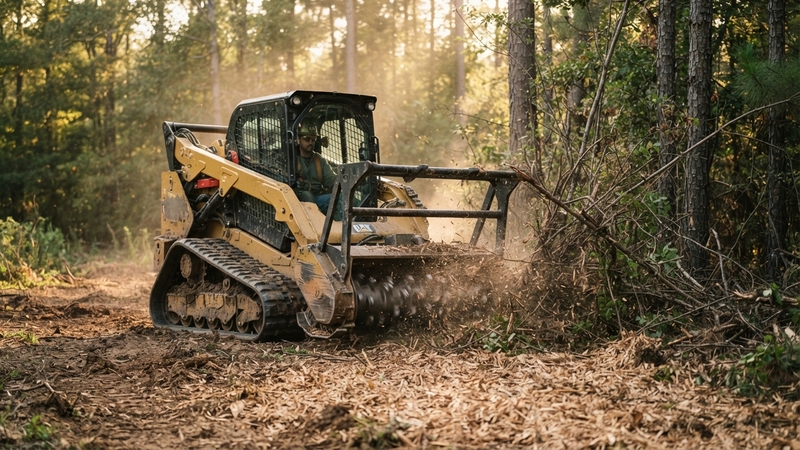
Summary:
- Forestry mulching clears trees, brush, and undergrowth in a single pass while leaving mulch on site to protect soil.
- The method reduces erosion risk, limits debris hauling, and prepares land for building, farming, or better access.
- Vaquero Landworks serves property owners across Milledgeville, GA, from a base in the USA.
Overgrown lots and wooded acreage often need more than a simple mowing to become usable again. Forestry Mulching grinds trees, brush, and undergrowth into mulch in a single pass, clearing land while leaving organic material behind to protect the soil.
The process differs from bulldozing or burning because it does not strip the ground bare. Instead, traditional clearing methods often strip the land bare, increasing runoff risk, while mulching leaves a ground layer of organic material that helps stabilize soil and retain moisture. That distinction matters most on properties with slopes, drainage ditches, or proximity to creeks, where exposed dirt can wash away after a heavy rain.
How Forestry Mulching Clears Overgrown Land
A mulching machine, typically a skid-steer or tracked unit fitted with a rotating head, cuts and grinds vegetation on contact. The resulting material stays on the property rather than being hauled away or burned.
Key characteristics of the process include:
- Single-pass clearing that handles trees, brush, vines, and underbrush together
- No burn piles or debris hauling required
- Root systems often remain partially intact, which helps limit soil disturbance.
- Mulch layer left behind supports moisture retention and weed suppression.
This approach is commonly used to prepare raw land for building, reclaim pastures, or reopen overgrown access roads and trails.
Soil and Erosion Benefits for Wooded Properties
Soil protection is one of the most cited advantages of mulching over conventional clearing. Because the ground isn’t scraped bare, the mulch layer acts as an immediate buffer against runoff.
Georgia’s forestry guidelines emphasize this same principle for any site preparation work. According to Georgia’s Best Management Practices for Forestry, the manual informs landowners and contractors about common-sense, economical, and effective practices to minimize non-point source pollution, including soil erosion and stream sedimentation. These practices are especially relevant to properties in Milledgeville, GA, where rolling terrain and seasonal rainfall can accelerate soil loss on any cleared ground.
Property owners weighing mulching against other clearing methods often ask about site disturbance and cleanup. The table below outlines general differences commonly cited in land management resources.
| Factor | Forestry Mulching | Traditional Clearing (Bulldozing/Burning) |
| Soil disturbance | Minimal, root systems often remain | Heavy equipment can compact and expose soil |
| Debris handling | Processed on site as mulch | Often requires hauling or burn permits |
| Erosion exposure | Mulch layer provides ground cover | Bare soil left exposed to runoff |
| Site access after clearing | Ready sooner for grading or planting | May require additional cleanup steps |
When Forestry Mulching Fits a Property’s Needs
Not every wooded lot needs the same clearing approach. Forestry mulching tends to suit properties where selective clearing, firebreak creation, or right-of-way maintenance is the goal rather than full excavation.
Common applications include:
- Reclaiming pastureland or hunting tracts that have grown over with brush
- Clearing building envelopes ahead of construction or septic work
- Opening driveways, fire lanes, or utility access routes
- Reducing wildfire fuel load around structures
Based in the USA, Vaquero Landworks serves property owners across Milledgeville, GA, providing context for how clearing decisions are made on individual sites. Soil type, slope, and intended land use typically determine whether mulching alone is sufficient or whether additional grading follows.
Frequently Asked Questions
Does forestry mulching remove stumps and roots? Mulching grinds surface vegetation and smaller stumps, but larger root systems can remain in the ground depending on the equipment and project scope.
Is forestry mulching suitable for sloped land? Sloped sites often benefit from mulching because the retained ground cover helps reduce runoff compared to clearing methods that leave bare soil exposed.
How long does forestry mulching take on an overgrown lot? Project duration depends on acreage, vegetation density, and terrain, so timelines vary from one property to the next.
Can mulched land be used immediately for building or farming? Once cleared, land is generally more accessible for grading, planting, or construction planning, though some sites may need additional site preparation steps first.
Property-specific scheduling and site assessment details for Vaquero Landworks are available for review before project planning begins.