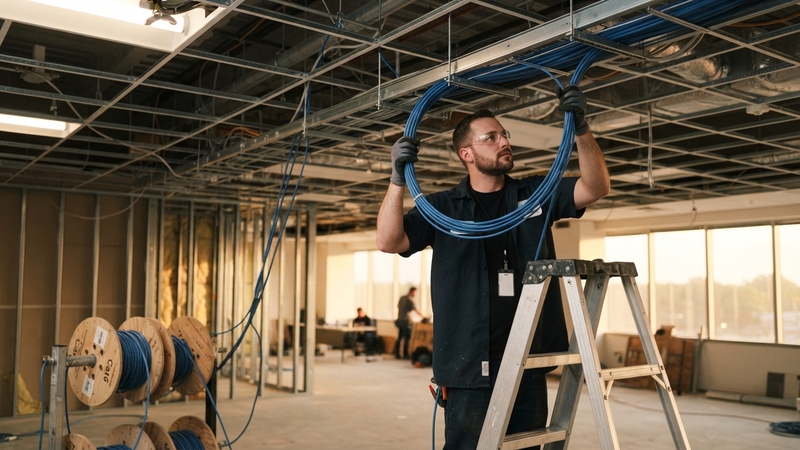
Recap:
- A low voltage contractor designs and installs structured cabling, fiber optic, wireless, and security systems that operate below standard electrical voltage thresholds.
- Businesses in Fort Myers, FL rely on these systems for data, voice, video, and security infrastructure.
- Verified offerings include structured cabling, fiber optic installation, wireless network setup, and security camera systems.
A low voltage contractor designs, installs, and maintains the cabling and electronic systems that carry data, voice, video, and security signals at voltage levels below standard electrical wiring. This distinct trade supports the technology backbone that modern commercial buildings depend on daily.
Commercial facilities across Fort Myers, FL increasingly depend on structured infrastructure to support day-to-day operations, from office networks to warehouse scanning systems. is one example of a licensed provider offering these services in the low-voltage contracting field.
What a Low Voltage Contractor Actually Does
Low voltage work covers a specific category of electrical systems that operate at reduced voltage compared to standard power wiring. These systems typically include:
- Structured cabling for data, voice, and video transmission
- Fiber optic backbone installation for high-bandwidth connectivity
- Wireless network design and setup
- Security camera system installation
- Data wiring for workstations, phones, and access points
Unlike standard electrical contractors who handle power distribution, low voltage specialists focus on communication and information systems. Industry installation practices are often guided by standards published through organizations such as BICSI, which maintains technical guidance for telecommunications and structured cabling design used across commercial construction projects.
Why Commercial Properties Need Structured Systems
Offices, warehouses, medical facilities, and distribution centers all rely on dependable network infrastructure to function. A poorly planned cabling system can lead to slow connectivity, frequent outages, or costly rework later.
Structured cabling systems typically combine several components working together:
- Data wiring infrastructure for consistent device connectivity
- Fiber optic backbone systems supporting long-distance, high-speed transmission
- Wireless network integration for mobile and cloud-based operations
- Security camera systems tied into the same low-voltage infrastructure
These components are generally planned and installed as a single coordinated system rather than isolated add-ons, which helps reduce compatibility issues and future maintenance costs.
Service Delivery Across Southwest Florida
Based in the USA, we serve commercial clients across Fort Myers, FL, supporting businesses that need coordinated technology infrastructure without relying on multiple disconnected vendors. Commercial low voltage work in this category generally spans several property types.
| Facility Type | Common Low Voltage Needs |
| Office buildings | Structured cabling, wireless networks |
| Warehouses | Fiber backbone, wireless scanning support |
| Medical facilities | Data wiring, security camera systems |
| Distribution centers | High-device-count network infrastructure |
Fort Myers, FL’s growing commercial and industrial base means more facilities are being built or renovated with technology infrastructure planned in from the start rather than retrofitted later. Coastal climate conditions in the region also make proper cable pathway planning and equipment housing a practical consideration for long-term system reliability.
Choosing Between DIY and Professional Installation
Some business owners consider handling basic network wiring internally before deciding whether professional installation is necessary. The comparison below outlines general trade-offs.
| Factor | DIY Approach | Professional Low Voltage Contractor |
| Code compliance | Uncertain | Installed per industry standards |
| Scalability | Limited | Designed for future growth |
| System integration | Fragmented | Coordinated across cabling, fiber, wireless |
| Documentation | Rare | Testing and certification typically included |
Facilities with multiple devices, security requirements, or expansion plans generally benefit from professional design rather than piecemeal wiring added over time.
Frequently Asked Questions
What is the difference between low voltage and standard electrical work? Low voltage systems carry data, voice, video, or security signals at reduced voltage levels, while standard electrical work involves higher-voltage power distribution for lighting, outlets, and equipment.
What types of buildings use low voltage contracting services? Offices, warehouses, medical facilities, and distribution centers commonly require structured cabling, fiber optic installation, wireless networks, and security camera systems.
Does structured cabling support both current and future technology needs? Structured cabling systems are typically designed for scalability, allowing facilities to add devices or expand coverage without a full system overhaul.
Is fiber optic installation part of low voltage contracting? Yes, fiber optic backbone installation is a standard component of commercial low voltage infrastructure, particularly for facilities requiring high-bandwidth, long-distance connectivity.
Facility managers researching infrastructure options can review current service details for CommX Networks as part of broader planning for commercial technology upgrades.